
Claude Fable 5.1 Is Out: What Changed and Can Your Plan Use It
Claude Fable 5.1 shipped on September 1, 2026. Fable sits at the very top of Anthropic's Claude lineup, and 5.1 arrives just two months after Fable 5 launched in July 2026.
The official announcement is full of price-cut percentages and benchmark scores. If you pay a monthly subscription, dollars per million tokens is not a number you ever see. What actually stirred the community on launch day was something the announcement never mentions: a usage limit reset.
So this post starts with whether your plan can use it, then checks what happened with the limit reset. After that it translates the improvements and the changes subscribers will actually feel, and ends with a call on whether to switch now. Everything is as of September 2026.
- Claude Fable 5.1
Anthropic's model for the hardest reasoning and long-horizon agent work. It is also the slowest model in the lineup.
Fable 5.1 availability: included on Max, credits on Pro
The answer depends on your plan. Based on the official support article, it breaks down like this.
| Plan | Fable 5.1 access |
|---|---|
| Max | Included at no extra cost, up to 50% of your weekly limit |
| Team and Enterprise premium seats | Same terms as Max |
| Pro | Not included; requires usage credits on top of the subscription |
| Team and Enterprise standard seats | Usage credits, if an admin enables it |
The 50% is easy to misread. It does not mean you get half a limit extra. Fable 5.1 draws from the same weekly limit as every other model. The 50% is simply the largest share of that shared limit Fable is allowed to take, and it resets together with the weekly limit. The support article does not mention the Free plan. Pricing and plan terms change often, so check the official page before you rely on any of this.

The launch modal showed up on my screen too, with the same line about being included in up to 50% of Max plan usage. It also introduces the model's habits: following requests precisely and asking when something is unclear, building complete spreadsheets while checking the numbers, and citing sources while separating facts from estimates.
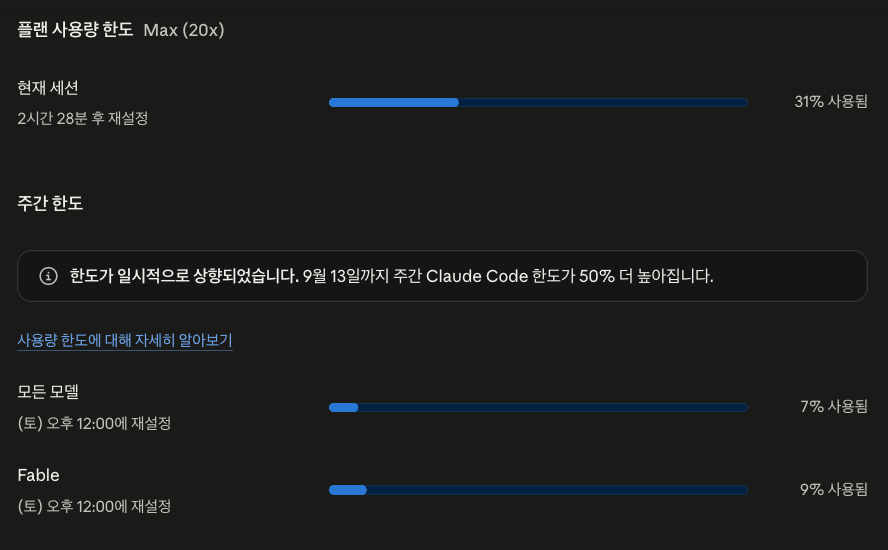
On the Max 20x usage screen, "All models" and "Fable" appear as separate bars, with the Fable bar tracking that 50% share inside the weekly limit. When I captured this, all models sat at 7% and Fable at 9%, both resetting Saturday at noon, while the current session was at 31% with 2 hours 28 minutes to go. Each limit resets on its own clock.
The same screen carries one more notice: weekly Claude Code limits are 50% higher through September 13. That temporary boost is separate from the launch-day reset described below.
The launch-day limit reset
Something else happened on September 1. As Fable 5.1 opened up, both the 5-hour usage window and the weekly window reset. Confirmation posts piled up across communities the same day, including a full reset on a Max 20x plan. Mine reset too. There is precedent: community records show the same thing happened when Fable 5 launched in July 2026, which makes this the second time. Two data points are still too few to call it a tradition.
Not everyone was celebrating. Some people had been rationing their usage all week with the weekly reset in sight. If your reset was two hours away, or ninety minutes away, and a full reset landed anyway, every bit of usage you saved by holding back became meaningless. Communities floated an alternative: let users bank resets and spend them when they choose. That alternative shipped with the Opus 5.5 launch on September 22, 2026. Anthropic now grants subscribers a limit reset they can save and use when they choose, and the official guide describes where to use it and how expiry works.
My frustration ran the other way. I had barely used anything when the reset hit. Had I known, I would have spent freely instead of saving. So next time rumors of a new model start circulating, I plan to burn my remaining limit in advance. If the reset never comes I just wasted my limit, but having been caught out once, it feels like a bet worth taking.
You can check whether your account reset on the usage screen in Claude's web settings. In Claude Code, type /usage at the prompt.
What the benchmarks say about the gains
Now for what improved. The official what's-new document lists gains in long coding sessions, document work across docs, spreadsheets, and slides, research and search, vision on dense charts and PDF tables, long-context handling at one million tokens, and computer use. If you are not a developer, the difference will most likely show up when you feed it long material or have it weave multiple files into one deliverable.
How much better is published as benchmark scores. A benchmark is a test that gives models the same tasks and compares success rates. The "What it tests" column below is not an official definition, just each benchmark's name unpacked in plain terms.
| Official benchmark | What it tests | 5.1 | 5 |
|---|---|---|---|
| Terminal-Bench-Science 0.1 | Completing scientific research tasks in a terminal | 52.6% | 24.7% |
| Terminal-Bench 4.0 | Completing coding tasks in a terminal | 55.8% | 42.0% |
| Humanity's Last Exam | A hard knowledge exam taken without tools | 60.9% | 57.8% |
| CursorBench 3.2.0 | Real-world code editing | 73.4% | 70.5% |
| OSWorld 2.0 | Operating a computer screen directly | 41.7% | 36.1% |
The biggest jump is scientific research, where the success rate more than doubled from 24.7% to 52.6%, and cybersecurity false positives dropped 60%. The other subjects rose by a few percentage points each, which reads more like refinement than revolution.
One fact matters if you mostly work in languages other than English. Multilingual performance is unchanged in this update. The official document states it matches Fable 5, so answers in your language will not get noticeably better. What did move is the model's knowledge, now refreshed through June 2026. Anything after that still needs search.
The specs behind long work: a one-million-token context window with up to 128K output tokens.
The price cut is for the API, your subscription stays the same
The official announcement says typical workloads cost about 25% less and tool-heavy agent workloads up to 45% less. Here is the thing: if you pay for a plan like most of us, this cut barely concerns you. The reason is that you pay in a different way. What dropped is API pricing, and the API is how developers connect Claude to other services and pay per token used. When the per-token rate falls, the bill for the same work falls with it.
Subscriptions work differently. You pay a flat monthly fee and use the model within your plan's limits, so a lower per-token API rate changes nothing on your bill.
Does that leave subscribers with nothing? One signal survives. The only item that actually dropped is cache reads, the cost of re-reading the earlier part of a long conversation. Input and output stay at $10 and $50 per million tokens, same as Fable 5, while cache reads fell 75% to $0.25. Cutting that one price to a quarter says the model has been tuned to favor work that keeps one long conversation going. What changes for subscribers is not the bill but this behavior, and how the limits inside the plan get spent.
Behavior changes you will notice in chat
The official document also itemizes how Fable 5.1 behaves differently from Fable 5. You will feel these in plain chat, no code required.
| Behavior | What changed in Fable 5.1 |
|---|---|
| Tool calls | Sometimes calls tools one per turn instead of batching them. Costs more tokens and time; answer quality is unchanged |
| Progress updates | Fewer interim notes during long tasks, so long work looks quieter |
| Search | With effort set low, it searches less and answers from memory more often |
| Prose | Longer sentences and fewer paragraph breaks, so text reads denser |
| Formatting | Uses less bold, fewer headers and lists in chat |
| Summaries | More likely to lift source phrasing without quotation marks when summarizing documents |
| File edits | Tends to rewrite whole files even for small changes. More output tokens and time |
Put together: work that runs one long conversation of analysis and writing got more efficient, while work that calls many tools or edits files frequently actually got less efficient. That is why "it got cheaper across the board" is the wrong takeaway.
This table also explains the split reactions. Korean communities reported "feels like twice the usage," while English communities observed "it burns more tokens." No contradiction. The first is about the launch-day reset restoring what people could spend. The second is about the first and last rows of the table raising what one job costs.
An invisible AI watermark arrives
Separate from performance, there is news. Did you know that text written by AI will now carry an invisible marker saying so? It applies starting with Fable 5.1. The official support article explains that Claude models released after August 2, 2026 support the mark from launch; today that means Fable 5.1 and Claude Mythos 5.1, with earlier models still being worked on.
The technique is a statistical text watermark. Readers cannot perceive it, and the text itself does not change: no extra tokens, no hidden characters, and no user or organization information embedded. It applies identically across every surface where the model is offered, worldwide. (Images and video made through the code execution tool get a separate marker, C2PA Content Credentials.)
One caveat: the detection tool is in a private preview open only to regulators, law enforcement, and researchers, so ordinary users cannot check a text themselves. How the watermark works and where verification hits its limits deserve their own post.
Where Fable 5.1 earns its keep: heavy analysis and long documents
Start with the hierarchy, because the names invite confusion. Skipping Fable 5.1 does not mean falling back to Fable 5. The official docs recommend starting most work with Opus 5. Fable is the model you reserve for the hardest reasoning and long-horizon agent work, and it is the slowest in the lineup. Fable 5 is not going away either; it stays available as a legacy model.
I keep Opus 5 as my default and reach for Fable 5.1 only when a heavy job will run through one long conversation, like a lengthy analysis or a large document build. I have reasons. Using it myself, Fable burns through the limit noticeably fast. Community reviews lately have trended toward "not as good as expected." And most of my work simply does not need it; Opus 5 has been enough. That said, building documents, spreadsheets, and slides together, or feeding it dense PDFs and charts, is exactly where Fable 5.1 fits.
Being on Max is not a free pass to experiment either. The 50% share is capped, but it still spends from the same shared weekly limit, so every token that goes to Fable is a token unavailable to other models. On Pro there is even less reason to rush: credits cost extra on top of the subscription, so make sure a task genuinely needs Fable's long context and hard reasoning before paying for it.
- Max and premium organization seats get Fable 5.1 at no extra cost, up to 50% of the weekly limit. Pro and standard seats need usage credits.
- The 50% is not extra capacity. It is the maximum share Fable can take of the same weekly limit every model draws from.
- On launch day, September 1, both the 5-hour and weekly usage windows reset, the second launch-day reset after Fable 5 in July.
- The biggest benchmark gain is scientific research, 24.7% to 52.6%. Multilingual performance is unchanged from Fable 5.
- The API price cut does not touch a subscriber's bill. Cheaper cache reads favor long single conversations, but one-tool-per-turn calls and whole-file rewrites can raise what a job costs.
- Start most work on Opus 5 and save Fable 5.1 for heavy analysis and long document work.
Frequently asked questions
Can I use Fable 5.1 on Claude Pro?
It is not included in the Pro plan. You can use it by purchasing usage credits on top of your subscription. Team and Enterprise standard seats also use credits, if an admin enables access.
Does the Max 50% mean my weekly limit grows by half?
No. Fable 5.1 draws from the same weekly limit as every other model, and 50% is the maximum share it can take. That share resets together with the weekly limit.
How do I check whether my account's limits were reset?
Open the usage screen in Claude's web settings. In Claude Code, type /usage at the prompt to see what remains.
Did Korean or other non-English performance improve in Fable 5.1?
The official what's-new document states multilingual performance matches Fable 5, so there is no basis for expecting better answers in other languages.
Is Fable 5 going away?
No. Fable 5 remains available as a legacy model.
What is Claude Mythos 5.1, announced alongside it?
The same model as Fable 5.1 with a different level of safeguards. It is currently limited to invited US organizations, so it is not an option for individual users.
Sources (6)Expand to see all sources
- Claude Help Center: What is a limit reset? Effective September 22, 2026 (checked 2026-09-30)
- Anthropic announcement, Introducing Claude Fable 5.1 and Claude Mythos 5.1, pricing and benchmarks (checked 2026-09-02)
- Claude Platform Docs, Models overview, model IDs, context, knowledge cutoff (checked 2026-09-02)
- Anthropic Help Center, Claude Fable models on your plan, per-plan terms and the 50% rule (checked 2026-09-02)
- Claude Platform Docs, What's new in Claude Fable 5.1, behavior changes from Fable 5 and the watermark (checked 2026-09-02)
- Anthropic Help Center, How Claude marks AI-generated content, watermark scope and detection tool (checked 2026-09-02)